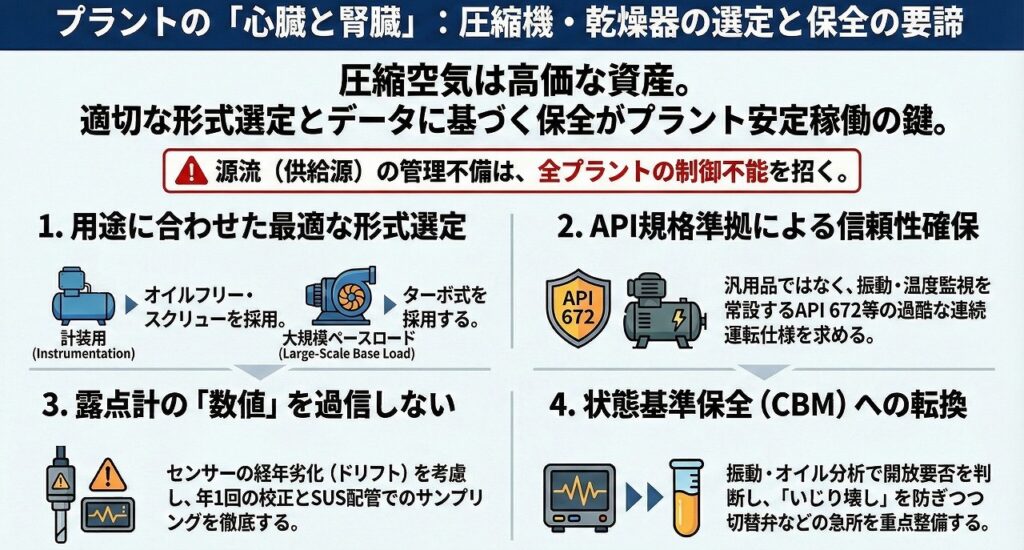
本記事は、プラントの「心臓」とも言えるエアコンプレッサー(圧縮機)と、その「腎臓」であるエアドライヤー(乾燥器)の選定・保全について深掘りします。
スクリュー式とターボ式の使い分けをAPI規格の視点から解説し、トラブルの元凶となる吸着剤の劣化メカニズムや、露点管理の盲点を指摘。
定検工事(SDM)におけるオーバーホールの判断基準まで、設備寿命を延ばし、かつ安定供給を守るための技術的知見を共有します。
源流を制する者がプラントを制する
これまで、計装空気(IA)、雑用空気(PA)、そしてプロセス空気について、配管や末端の視点からお話ししてきました。いわば「血管」の話でした。
しかし、どれほど血管が健全でも、送り出す「心臓」が不整脈を起こしていては、プラントは健全に稼働しません。
今回は供給源である「圧縮機」と「乾燥器」にメスを入れます。 「コンプレッサーなんて、回っていればいいんだろう?」 そんな考えは、今日ここに置いていってください。
供給源の選定ミスや保全不良は、全プラントの計器を狂わせ、制御不能に陥らせるポテンシャルを持っています。 今回は少しハードな機械寄りの話になりますが、最後までお付き合いください。
圧縮機の選定:スクリューか、ターボか
設計段階で最も頭を悩ませるのが、圧縮機の形式選定です。プラントの規模や負荷変動によって、最適な解は異なります。
オイルフリー・スクリュー圧縮機(API 619準拠)
中規模以下のプラントや、負荷変動が激しい系統で採用されるのがスクリュー式です。
特性: 2本のローターが噛み合いながら空気を圧縮します。容積式であるため、圧力変動に対して流量が安定しています。
設計のポイント: 計装用空気として使う場合、絶対に「オイルフリー」を選定します。油分が混入すれば、下流の計器類が全滅するからです。
弱点と対策: 脈動(Pulsation)が発生しやすいのが特徴です。吐出配管の設計では、脈動解析を行い、必要に応じてパルセーションダンパー(脈動減衰器)やサイレンサーを設置しないと、配管振動によるクラック割れを招きます。
ターボ(遠心)圧縮機(API 672準拠)
大規模プラントのベースロード機として君臨するのがターボ式です。
特性: 高速回転するインペラで速度エネルギーを圧力に変換します。大流量を高効率で供給できますが、サージング(脈動)のリスクと隣り合わせです。
設計のポイント: 吸気フィルターの選定が命です。冷却塔(クーリングタワー)のミストを吸い込む位置に吸気口があると、インペラにスケールが付着し、バランス崩れや腐食を引き起こします。
制御: IGV(Inlet Guide Vane:吸込案内羽根)による容量調整が一般的です。これにより、部分負荷時でも効率よく運転できます。
API規格に見る「本気」の仕様
我々のようなプラントでは、汎用品ではなくAPI(アメリカ石油協会)規格に準拠したマシンを要求することが多いです。
API 672 (Packaged Integral Geared Centrifugal Air Compressors) いわゆる「ギヤ増速式」のパッケージ型ターボコンプレッサーの規格です。
この規格が求めているのは、過酷な連続運転に耐えうる「堅牢性」と「メンテナンス性」です。 例えば、軸受(ベアリング)の温度監視や、振動監視モニター(Bently Nevada等)の常設が推奨されます。
設計担当者は、ベンダー標準仕様を鵜呑みにせず、「API 672のこの項目の適用はどうなっているか?」と問いかける視座が必要です。
露点計の嘘と真実:信頼性管理の要諦
「中央操作室(DCS)で露点が-40℃を指しているから安心」 ……本当にそうでしょうか?
露点計(Dew Point Meter)のセンサー、特に静電容量式や酸化アルミニウム式のセンサーは、経年劣化で「感度が鈍る(ドリフトする)」傾向があります。つまり、実際は湿っているのに、計器はずっと「-40℃」という快適な数値を出し続けることがあるのです。
設計・保全の急所として、以下を推奨します。
- 校正の義務化: 少なくとも1年に1回はメーカー校正に出すか、ポータブル露点計で比較測定を行う。
- サンプリング配管の工夫: 露点計への導圧管は、水分が滞留しないよう最短距離で、かつステンレス管(SUS316)を使用する。チューブ配管(銅や樹脂)は吸湿性や透過性があるため、微量水分の測定には不向きです。
定検工事(SDM)における保全の急所:オーバーホール判断基準
さて、いよいよ定検工事です。圧縮機を開放するか否か、その判断基準はどこに置くべきでしょうか。
時間基準保全(TBM)から状態基準保全(CBM)へ
かつては「4年または24,000時間で必ず開放」といったTBMが主流でしたが、最近はコストとリスクの観点からCBMへ移行しつつあります。 無闇に開放することは、逆に異物混入や組立精度の低下を招くリスク(いじり壊し)があるからです。
診断技術の活用
開放スキップを判断するための「武器」を持ちましょう。
- 振動解析: 軸振動のスペクトル解析を行い、アンバランス、ミスアライメント、油膜不安定などの兆候がないか確認する。
- オイル分析: 潤滑油中の摩耗粉(フェログラフィ)を分析し、軸受やギアの異常摩耗を早期発見する。
- トレンド管理: インタークーラーの差圧や温度効率のトレンドを見て、内部のスケーリング状況を推測する。
これらのデータが健全であれば、主要部品の開放を見送り、消耗品(シール類、フィルター、オイル)の交換に留めるという戦略的な判断が可能になります。
ドライヤー切替弁のメンテ
ドライヤーで最も故障が多いのは、吸着・再生を切り替える「四方弁(または三方弁)」です。 数分〜数十分おきに動作し続けるため、パッキンの摩耗やアクチュエーターの不具合が頻発します。
SDM期間中は、吸着剤の入替作業と並行して、この切替弁のフルオーバーホール(全分解・パッキン全交換)を強く推奨します。
「まだ動くから」と見逃すと、次のSDMまで持ちこたえられず、中間期にラインを止める羽目になります。
空気はタダではない、そして止まらない
ここまで、計装空気、雑用空気、プロセス空気、そして今回の供給源と、4回にわたり「空気」について語らせていただきました。
空気は大気中に無限にありますが、我々が使う「圧縮空気」は、膨大な電力と、精緻な設計、そして泥臭い保全活動によって作られた、極めて高価な製品です。
たかが空気と侮るなかれ。その一吹きには、プラントの安定稼働を願うエンジニアたちの魂が込められています。
圧縮機の唸り音が、心地よいBGMとして聞こえるようになったら、あなたも一人前の「プラント屋」かもしれません。
皆様の現場が、今日も、そして次の定検後も、健全な呼吸を続けられることを祈っております。
Selection and Service Life Assessment of Compressors and Dryers
This article delves into the selection and maintenance of air compressors, which can be considered the "heart" of a plant, and air dryers, which are its "kidneys."
This article explains the differences between screw-type and turbo-type decompressors from the perspective of API standards, and points out the degradation mechanisms of adsorbents that are the root cause of problems, as well as blind spots in dew point management.
We will share technical knowledge to extend equipment lifespan and ensure stable supply, including criteria for determining overhauls during scheduled maintenance (SDM).
He who controls the source controls the plant
Up until now, we've discussed instrumentation air (IA), general-purpose air (PA), and process air from the perspective of piping and end-users. It was, so to speak, about the "blood vessels" of the system.
However, no matter how healthy the blood vessels are, if the "heart" that pumps the energy is experiencing arrhythmias, the plant will not function properly.
This time, we'll be focusing on the "compressor" and "dryer," which are the sources of the supply. "Isn't it enough for the compressor to just run?" Leave that kind of thinking behind today.
Mistakes in selecting supply sources or poor maintenance have the potential to disrupt all plant instruments and lead to a loss of control. This time, we'll be discussing some rather technical, mechanical aspects, but please bear with us until the end.
Compressor selection: Screw or turbo?
The most challenging aspect of the design phase is selecting the appropriate compressor type. The optimal solution varies depending on the plant's size and load fluctuations.
Oil-free screw compressor (API 619 compliant)
Screw-type propellers are used in small to medium-sized plants and in systems with significant load fluctuations.
Features: Two rotors mesh together to compress air. Because it is a positive displacement compressor, the flow rate remains stable even with pressure fluctuations.
Design point: When using it as instrumentation air, you must select "oil-free" air. If oil is mixed in, all downstream instruments will be destroyed.
Weaknesses and countermeasures: A key characteristic is that it is prone to pulsation. In the design of discharge piping, pulsation analysis must be performed, and if necessary, pulsation dampers or silencers must be installed; otherwise, it will lead to cracking due to pipe vibration.
Turbo (centrifugal) compressor (API 672 compliant)
Turbocharged engines reign supreme as base-load machines for large-scale plants.
Characteristics: The high-speed rotating impeller converts kinetic energy into pressure. It can supply large flow rates with high efficiency, but it is always accompanied by the risk of surging (pulsation).
Design point: The selection of the intake filter is crucial. If the intake port is located where the cooling tower mist is drawn in, scale will accumulate on the impeller, causing imbalance and corrosion.
Control: Capacity adjustment is typically done using an IGV (Inlet Guide Vane). This allows for efficient operation even at partial load.
Serious specifications as seen in API standards
Plants like ours often require machines that comply with API (American Petroleum Institute) standards rather than generic parts.
API 672 (Packaged Integral Geared Centrifugal Air Compressors) is a standard for packaged turbo compressors, also known as "geared" turbo compressors.
This standard requires "robustness" and "maintainability" to withstand harsh, continuous operation. For example, permanent installation of bearing temperature monitoring and vibration monitoring devices (such as Bently Nevada) is recommended.
Designers need to avoid blindly accepting vendor standard specifications and instead ask questions like, "How does this item in API 672 apply?"
The Truth and Lies of Dew Point Meters: Essentials of Reliability Management
"The dew point is showing -40°C in the DCS (Direct Control System), so we can rest assured." ...But is that really true?
Dew point meter sensors, especially capacitive and aluminum oxide sensors, tend to lose sensitivity (drift) over time. This means that even when it's actually damp, the instrument may continue to display a comfortable reading of "-40°C".
We recommend the following as key points for design and maintenance:
Mandatory calibration: At least once a year, the equipment must be calibrated by the manufacturer or comparative measurements must be taken using a portable dew point meter.
Sampling piping design considerations: The pressure sensing tube to the dew point meter should be the shortest possible distance and made of stainless steel (SUS316) to prevent moisture buildup. Tube piping (copper or resin) is unsuitable for measuring trace amounts of moisture due to its hygroscopic and permeable properties.
Key points of maintenance in scheduled maintenance (SDM): Overhaul decision criteria
Now, it's finally time for the scheduled inspection. What criteria should we use to decide whether or not to open the compressor?
From Time-Based Maintenance (TBM) to Condition-Based Maintenance (CBM)
Previously, the dominant approach was TBM (Track-Based Manufacturing), which mandated "opening after 4 years or 24,000 hours." However, recently, there's been a shift towards CBM (Condition-Based Manufacturing) due to cost and risk considerations. Opening components unnecessarily carries the risk of foreign object contamination and a decrease in assembly accuracy (due to tampering and damage).
Application of diagnostic technology
Let's have the "weapons" to decide whether to skip unlocking content.
Vibration analysis: Perform spectral analysis of axial vibrations to check for signs of unbalance, misalignment, oil film instability, etc.
Oil analysis: Analyzes wear particles (ferrography) in lubricating oil to detect abnormal wear in bearings and gears at an early stage.
Trend management: Observe trends in the intercooler's differential pressure and temperature efficiency to infer the internal scaling status.
If this data is healthy, it becomes possible to make a strategic decision to postpone opening up major components and limit the work to replacing consumables (seals, filters, oil).
Maintenance of the dryer's selector valve
The most common component that malfunctions in hair dryers is the "four-way valve (or three-way valve)" that switches between suction and regeneration. Because it operates continuously every few minutes to tens of minutes, wear and tear on the packing and actuator malfunctions occur frequently.
During the SDM period, we strongly recommend a full overhaul (complete disassembly and replacement of all packings) of this switching valve, in parallel with the adsorbent replacement work.
If you overlook it because "it's still running," you won't be able to hold out until the next SDM (Structured Determination Meeting), and you'll end up having to stop the line in the middle of the period.
Air isn't free, and it never stops flowing.
So far, we've discussed "air" over four installments, covering instrumentation air, general-purpose air, process air, and now, its supply sources.
While air is infinitely abundant in the atmosphere, the "compressed air" we use is an extremely expensive product, produced through enormous amounts of electricity, sophisticated design, and painstaking conservation efforts.
Don't underestimate the power of air. Every puff contains the passion of engineers who wish for the stable operation of the plant.
If the hum of the compressor starts to sound like pleasant background music, you might just be a full-fledged "plant engineer."
I pray that your workplaces will continue to function healthily today and after the next scheduled inspection.