プラントの血管とも言えるユーティリティ設備の中で、意外と軽視されがちな「雑用空気(PA)」に焦点を当てます。
本記事では、計装用空気(IA)との設計仕様の違い、水分(ドレン)に起因する配管腐食メカニズム、そして定検工事(SDM)における保全の急所について、現場経験に基づき解説します。
また、省エネの観点から無視できない「エア漏れ」対策についても、具体的な設計思想を交えて詳述します。
たかが雑用、されど生命線
「計装空気(IA)なら露点管理やオイルフリーが重要だけど、PAなんて要はただの圧縮空気でしょ?」
そんなふうに思われがちですが、実はPAこそが、定検工事(SDM)や日常保全の作業効率、ひいては作業員の安全を支える生命線なのです。
エアツールが動かない、ホースから錆水が噴き出す、そんなトラブルで工事の手を止めるわけにはいきません。
一見地味なPAラインに潜むリスクと、それを回避するための設計・保全の勘所。少しマニアックになりますが、次回の工事に役立つ知識としてお話しさせていただきます。
雑用空気(PA)と計装空気(IA)の決定的な違い
まず、設計の前提条件となる流体の性状について整理しましょう。ここが配管スペックを決める出発点です。
計装空気(IA)は、ご存知の通り、コントロールバルブや計器類を動かすための「神経」です。そのため、エアドライヤーを通して露点を-20℃〜-40℃程度(大気圧換算)まで下げ、極限まで水分を除去します。
対して雑用空気(PA)は、エアインパクトレンチ、グラインダー、清掃用エアブロー、あるいはダイアフラムポンプの駆動源として使われます。
PAは、コンプレッサーで圧縮された後、アフタークーラーで冷却された程度の「ウェット(Wet)」な状態が一般的です。
つまり、配管内には常に飽和水蒸気が存在し、外気温の変化によってドレン(凝縮水)が発生するという前提で設計しなければなりません。
この「水がある」という条件が、配管材料の選定と腐食対策において決定的な差を生むのです。
PA配管の設計仕様:なぜ「白ガス管」なのか
設計担当の方なら馴染み深いと思いますが、PA配管の仕様書を見ると、多くのプラントで以下のようなスペックが採用されているはずです。
流体区分:Utility Air / Plant Air
設計圧力:0.7 ~ 0.9 MPaG
設計温度:Ambient ~ 60℃(コンプレッサー吐出付近は高温注意)
管種:SGP(配管用炭素鋼鋼管)+ 溶融亜鉛めっき(いわゆる白ガス管)
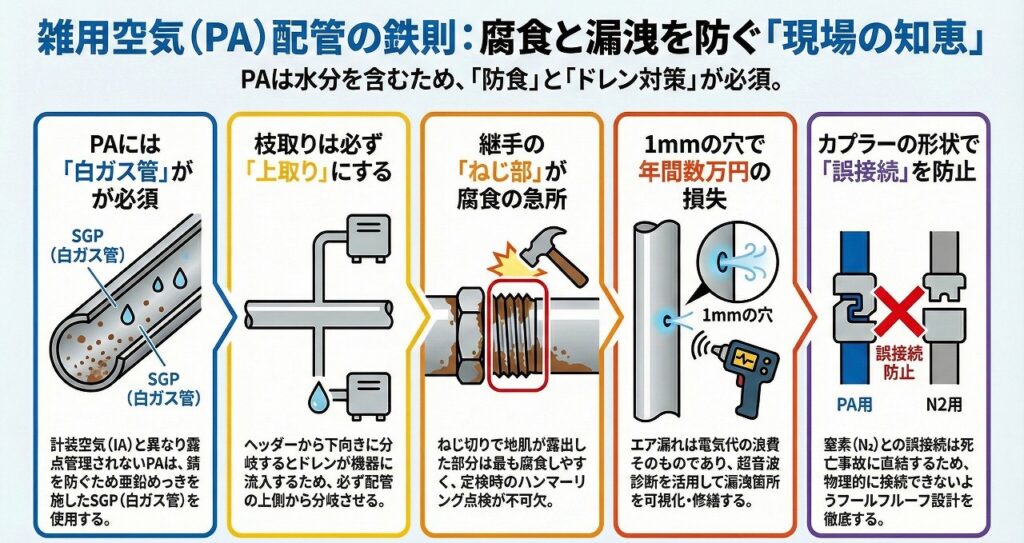
ここで重要なのが「溶融亜鉛めっき」です。 IAラインでは、乾燥しているため通常の炭素鋼(黒管)を使用することもありますが、PAは前述の通りドレンが発生するため、黒管ではあっという間に内面腐食が進行し、赤錆が発生します。
この赤錆が剥離して末端に流れると、エアツールのフィルターを詰まらせたり、シリンダーを傷つけたりして故障の原因となります。
したがって、小口径(2インチ以下など)のPA配管には、JIS G 3452に基づくSGPに亜鉛めっきを施した「白ガス管」を採用し、継手もねじ込み式の「白継手」を使用するのがセオリーです。
ただし、主管(ヘッダー)など大口径(3インチ以上)になり溶接施工が必要な場合は、黒管(SGPやSTPG)を使用し、内面防食塗装を施すか、あるいは腐食代(Corrosion Allowance)を多めに見積もる設計となります。
最近ではライフサイクルコストを考慮して、主管にステンレス鋼(SUS304等)を採用するケースも増えてきましたが、コストとの兼ね合いになります。
ドレン対策と配管勾配の設計思想
PA配管の設計において、スペック以上に重要なのが「ルート計画」です。 湿った空気を運ぶ以上、配管内で発生した水は必ずどこかに溜まります。これを放置すると、以下のトラブルを引き起こします。
ウォーターハンマー:大量のドレンが高速で移動し、バルブやエルボを直撃する。
腐食の加速:水が溜まる箇所(滞留部)での集中腐食。
末端への噴出:作業員がエアブローをした瞬間、水が噴き出して対象物を汚染する。
これを防ぐための設計の鉄則は以下の通りです。
下り勾配の確保:流れ方向に対して、1/100 ~ 1/200 程度の下り勾配をつける。
ドリップレグ(水抜き)の設置:配管の最下点や立ち上がり手前には、必ずドレン溜まり(ドリップレグ)を設け、トラップやバルブで排出できるようにする。
枝取りは「上取り」:ヘッダーから分岐して各エリアへ供給する際、必ず配管の上側から分岐(Top Take-off)させる。下から取ると、ヘッダー内のドレンが全て末端機器へ流れ込んでしまいます。
図面チェックの際は、単に「つながっているか」だけでなく、「水がどう流れるか」を想像して検図していただけると、現場としては非常に助かります。
定検工事(SDM)における保全の急所:腐食と減肉
さて、ここからは保全・工事監督の皆様に向けた、定検時の重要チェックポイントです。PAラインは常時稼働していることが多く、SDMの時しか開放点検できない箇所があります。
ねじ込み部の腐食(隙間腐食)
白ガス管を使用している場合、直管部は亜鉛めっきで守られていますが、ねじ切りをした部分は鉄の地肌が露出しています。
施工時に防食シール剤やテープを適切に使用していても、経年で最も早く腐食するのがこの「ねじ部」です。
特に、屋外で雨水がかかる場所や、保温材の下(CUI)になっているねじ込み継手は、外面からの腐食と内面からのドレン腐食の挟み撃ちにあい、ポキリと折れるリスクがあります。
SDM期間中は、ユーティリティステーション周辺のあやしい継手をハンマーリングテストなどで点検することをお勧めします。
ドレン弁・ルート弁のシートリーク
PA配管の末端にあるドレン抜きバルブは、錆やスケールを含んだ水を排出するため、シート面が傷つきやすく、リーク(漏れ)の常習箇所です。
「閉めてもシューシュー音がする」バルブは、SDM期間中に交換が必要です。安価な汎用ボールバルブが使われることが多いですが、メンテナンス頻度を減らすために、接液部がステンレス製のものへグレードアップするのも一つの手です。
ユーティリティステーション(ホース接続口)の管理
各フロアに設置されているPAの取り出し口(カプラーやバルブ)。ここは日常的に作業員がホースを脱着するため、機械的な負荷がかかり、根元のニップルにクラックが入っていることがあります。
また、SDM工事本番では、多くの業者がここからエアを取ります。タコ足配線ならぬ「タコ足配管」になり、圧力が不足するトラブルも頻発します。
工事計画段階で、ピーク時に必要なエア量を試算し、既存のラインで足りない場合は仮設コンプレッサーや仮設配管(バイパス)を準備するのも、スムーズな工事遂行の鍵です。
プラントの省エネと漏洩対策:お金を空中に捨てないために
「エア漏れくらい、大したことない」 そう思われることもありますが、PAのエア漏れは、電気代の浪費そのものです。
0.7MPaのラインに1mmの穴が開いているだけで、年間で数万円〜十数万円分の電力がコンプレッサーの無駄な稼働として消えていくと言われています。
プラント全体で数千箇所から漏れていれば、その損失は莫大です。
超音波診断の活用
最近の保全トレンドとして、超音波式エア漏れ検知器の導入が進んでいます。人間の耳では聞こえない微細な漏れ音を可視化・聴覚化するツールです。
定検前の稼働中にサーベイを行い、漏れ箇所にタグを付けておき、定検期間中に一斉にパッキン交換や増し締めを行う。これをルーチン化するだけで、コンプレッサーの負荷率が目に見えて下がります。
漏れない設計への転換
設計段階でできる対策もあります。 先ほど「ねじ込み継手」が腐食しやすいと述べましたが、最近では小口径配管でも、可能な限りフランジ接続や溶接接続を採用する、あるいはシール性能の高い特殊な食い込み継手を採用するスペックも増えています。
イニシャルコストは上がりますが、将来の漏洩リスクと保全コスト(足場を組んでの増し締め等)を考えれば、十分にペイする投資です。
現場で役立つ「ちょっとした」気遣い
最後に、施工管理をする上で「気が利く」と言われるポイントを二つほど。
一つ目は、「バルブのハンドル位置」です。 PAのバルブは、緊急時や日常点検で頻繁に操作します。
設計図面上では問題なくても、現場に行くと手すりが邪魔で回せない、高すぎて届かない、ということが多々あります。 施工図(アイソメ)の段階で、オペレーターがアクセスしやすい位置にハンドルが向いているかを確認してください。
特にヘッダーからの取り出し弁は、チェーン操作式にするか、適切なステージからのアクセスを考慮する必要があります。
二つ目は、識別表示(カラーコード)」です。 SDM時は、窒素(N2)や計装空気(IA)など、様々な仮設ホースが入り乱れます。
もし、作業員が呼吸用エアとして誤って窒素ラインに接続したら...死亡事故に直結します。
PAの接続口には明確な表示を行い、カプラーの形状をN2とは変える(物理的に接続できなくする)などのフールプルーフ設計が必須です。これを徹底することが、現場の安全を守る監督者の責務です。
見えない空気に、意思を込める
雑用空気(PA)は、華やかなプロセス流体に比べれば脇役かもしれません。しかし、その配管の中には、プラントを安全に維持し、工事を円滑に進めたいという、我々の「意思」が詰め込まれています。
たかが空気、されど空気。 濡れた空気をどう導き、どう水を抜き、どう漏らさずに届けるか。その設計思想と保全の細やかさが、結果として大規模修繕工事の品質を底上げします。
次に現場で「シュー」というエア漏れの音を聞いたとき、あるいは錆びたバルブを見たとき、今回の話を思い出していただければ幸いです。 皆様の次の現場が、トラブルなく、安全に完遂されることを心より祈念しております。
Design and Maintenance of Service Air Systems
This article focuses on "passive air (PA)," a type of utility equipment that can be considered the lifeblood of a plant and is often overlooked.
This article explains, based on field experience, the differences in design specifications between instrumentation air (IA), the pipe corrosion mechanism caused by moisture (drain), and the critical points of maintenance in scheduled maintenance (SDM).
Furthermore, we will detail measures to address "air leaks," which cannot be ignored from an energy-saving perspective, along with specific design considerations.
It may seem like a trivial chore, but it's a lifeline.
"For instrument air (IA), dew point control and oil-free operation are important, but PA is basically just compressed air, right?"
It's easy to think that way, but in reality, PA (Patient Aid) is the lifeline that supports the efficiency of scheduled maintenance (SDM) and daily maintenance work, and ultimately, the safety of the workers.
We can't afford to stop construction work because of problems like air tools not working or rusty water spraying from hoses.
The risks hidden within seemingly unremarkable PA lines, and the key design and maintenance points to avoid them. This might get a little technical, but I'd like to share this knowledge that will be useful for your next construction project.
The definitive difference between general-purpose air (PA) and instrumentation air (IA)
First, let's clarify the fluid properties that are the prerequisites for the design. This is the starting point for determining the piping specifications.
As you know, instrument air (IA) is the "nerves" that powers control valves and instruments. Therefore, it is passed through an air dryer to lower the dew point to around -20°C to -40°C (at atmospheric pressure) and remove moisture to the absolute minimum.
In contrast, general-purpose air (PA) is used as a power source for air impact wrenches, grinders, cleaning air blowers, or diaphragm pumps.
PA (Pollutant Adapter) is typically in a "wet" state, having been compressed by a compressor and then cooled by an aftercooler.
In other words, the design must be based on the premise that saturated water vapor is always present inside the piping, and that condensate (drain water) is generated due to changes in the outside temperature .
The presence of water makes a crucial difference in selecting piping materials and implementing corrosion prevention measures.
PA Piping Design Specifications: Why "White Gas Pipes"?
Those involved in design will be familiar with this, but if you look at the specifications for PA piping, you'll find that many plants use the following specifications.
Fluid classification : Utility Air / Plant Air
Design pressure : 0.7 to 0.9 MPaG
Design temperature : Ambient to 60°C (Caution: High temperatures near compressor discharge)
Pipe type : SGP (carbon steel pipe for piping) + hot-dip galvanizing (so-called white gas pipe)
The key here is "hot-dip galvanizing." In IA lines, ordinary carbon steel (black pipes) can be used because they are dry, but as mentioned earlier, PA lines generate condensate, so black pipes would quickly corrode internally and develop red rust.
If this rust flakes off and flows to the end of the tool, it can clog the air tool's filter or damage the cylinder, causing malfunctions.
Therefore, for small-diameter (2 inches or less) PA piping, the standard practice is to use "white gas pipes" made of SGP (Steel Glycerin) coated with zinc plating, based on JIS G 3452, and to use threaded "white fittings" for the connections.
However, for large diameter pipes (3 inches or more), such as main pipes (headers), where welding is required, black pipes (SGP or STPG) are used, and the internal surface is coated with anti-corrosion paint, or the design incorporates a larger corrosion allowance.
Recently, with life cycle costs in mind, there has been an increase in cases where stainless steel (such as SUS304) is used for the main pipe, but this is a trade-off with cost.
Drainage measures and pipe gradient design principles
In PA piping design, "route planning" is even more important than specifications. Since humid air is being transported, water generated within the piping will inevitably accumulate somewhere. Leaving this unattended will lead to the following problems:
Water hammer : A large volume of condensate moves at high speed, directly hitting valves and elbows.
Accelerated corrosion : Concentrated corrosion in areas where water accumulates (stagnation points).
Spray at the end : The moment a worker uses an air blower, water sprays out and contaminates the object.
The following are the fundamental design principles to prevent this:
Ensuring a downward slope : A downward slope of approximately 1/100 to 1/200 relative to the direction of flow should be established.
Installation of drip legs : Always install drain reservoirs (drip legs) at the lowest point of the piping or before a riser, and allow for drainage via traps or valves.
Branching is done from the top : When supplying to each area by branching from the header, the branch must always be taken from the top of the piping (top take-off). If taken from the bottom, all the drain in the header will flow into the terminal equipment.
When checking the drawings, it would be extremely helpful for the construction site if you could not only check whether things are connected, but also imagine how the water will flow.
Critical points of maintenance in scheduled maintenance (SDM): corrosion and thinning.
Now, here are some important checkpoints for maintenance and construction supervisors during regular inspections. PA lines are often in constant operation, and there are parts that can only be opened and inspected during SDM (System Destruction Mechanism) inspections.
Corrosion of threaded parts (crevice corrosion)
When using white gas pipes, the straight sections are protected by zinc plating, but the threaded sections expose the bare iron surface.
Even if corrosion-preventive sealants and tapes are properly used during installation, the threaded portion is the part that corrodes the fastest over time.
In particular, threaded joints in outdoor locations exposed to rainwater, or those located under insulation (CUI), are at risk of snapping due to a combination of external corrosion and internal drain corrosion.
During the SDM period, we recommend inspecting any suspicious fittings around the utility station using hammering tests or similar methods.
Drain valve/root valve seat leak
The drain valve at the end of the PA piping is prone to leaks because it discharges water containing rust and scale, which can easily damage the seat surface.
Valves that make a hissing sound even when closed need to be replaced during the SDM period. While inexpensive general-purpose ball valves are often used, upgrading to a valve with stainless steel wetted parts is one way to reduce the frequency of maintenance.
Management of utility stations (hose connection ports)
The PA outlets (couplers and valves) installed on each floor are subjected to mechanical stress because workers regularly attach and detach hoses here, which can cause cracks in the nipples at the base.
Furthermore, during actual SDM construction, many contractors draw air from this point. This results in a "daisy-chain" of piping, and problems with insufficient pressure frequently occur.
During the construction planning stage, it's crucial to estimate the amount of air needed during peak hours and prepare temporary compressors and temporary piping (bypasses) if the existing lines are insufficient. This is key to ensuring smooth construction execution.
Energy conservation and leak prevention in plants: Don't throw money away into thin air
You might think, "An air leak isn't a big deal," but an air leak in a PA system is a complete waste of electricity.
It is said that even a 1mm hole in a 0.7MPa line can result in tens of thousands to over a hundred thousand yen worth of electricity being wasted annually on the compressor.
If leaks occur in thousands of locations throughout the entire plant, the resulting losses will be enormous.
Use of ultrasound diagnostics
A recent maintenance trend is the increasing adoption of ultrasonic air leak detectors . These tools visualize and make audible even the slightest leak sounds that are inaudible to the human ear.
By conducting a survey while the compressor is in operation before the scheduled inspection, tagging any leaks, and then performing gasket replacements and tightening all bolts simultaneously during the inspection period, the compressor load rate will noticeably decrease.
Shift to leak-proof design
There are also measures that can be taken during the design phase. Earlier I mentioned that threaded fittings are prone to corrosion, but recently, even for small-diameter piping, there is an increasing trend to use flange connections or welded connections whenever possible, or to use special bite-fitting fittings with high sealing performance.
While the initial cost will be higher, considering the future risk of leaks and maintenance costs (such as re-tightening with scaffolding), it is a worthwhile investment.
"Small" gestures that are useful on the job
Finally, here are two points that make you seem "thoughtful" when it comes to construction management.
The first point is the "position of the valve handle." PA valves are frequently operated in emergencies and during routine inspections.
Even if there are no problems on the design drawings, you'll often find that on site, the handle is in the way because of a handrail, or it's too high to reach. Please check at the stage of the construction drawings (isometric) that the handle is positioned in a location that is easily accessible to the operator.
In particular, the take-off valves from the header should be either chain-operated or accessed from an appropriate stage.
The second is "identification markings (color codes)." During SDM, various temporary hoses, such as nitrogen (N2) and instrument air (IA), become intertwined.
If a worker were to mistakenly connect a nitrogen line to breathing air, it would directly lead to a fatal accident.
Clear labeling is essential for PA connection ports, and foolproof design measures such as using a different coupler shape than N2 (to physically prevent connection) are mandatory. Ensuring this is the responsibility of supervisors to protect on-site safety.
Infusing intention into the invisible air.
Non-performing air (PA) may play a supporting role compared to the glamorous process fluids. However, within its piping lies our "determination" to maintain the plant safely and ensure the smooth progress of construction.
It may seem like just air, but it's more than just air. How do we guide the humid air, how do we remove the water, and how do we deliver it without any leaks? This design philosophy and meticulous maintenance ultimately raise the overall quality of large-scale repair work.
The next time you hear a hissing sound of air leaking or see a rusty valve at a job site, I hope you'll remember what I've told you today. I sincerely hope that your next job site will be completed safely and without any problems.